Losing 15 minutes cities
Nov 6, 2023

Hanoi and Saigon used to be amazing places, with many characteristics of a 15-minute city. However, we are slowly losing these qualities in our pursuit of a "modern lifestyle".
Why cities in Viet Nam actually have a lot of good characteristics that many cities in the US and EU yearn for?
Obviously, cities in developing countries like ours don't lack problems of their own. Issues such as overpopulation and a serious housing crisis, as well as traffic jams, still occur in Vietnam. However, it's interesting to see that many new urban design movements already exist in Vietnam, thanks to the versatility of the motorbike.
Motorbikes are very common in Asian cities like Hanoi, Saigon, Taiwan, and New Delhi. They combine the versatility of a bike, allowing you to easily travel anywhere, with the advantage of not taking up much space. This means there is no need to build four-lane streets and huge parking lots in front of shops. Additionally, motorbikes have an engine, enabling them to travel longer distances effortlessly. As a result, Vietnamese urban areas can grow closer to each other. In my case, I mainly use my motorbike for two purposes: commuting to work and hanging out with friends in central districts. For everything else, I can simply use my old bike. Therefore, our cities are ideal places to showcase the "15 minutes movement."
To be more precise, let's examine the four characteristics of a 15-minute city, as described by Carlos Moreno:
Proximity: Things must be close.
Diversity: Land uses should be mixed to provide a wide range of urban amenities nearby.
Density: There should be enough people to support a variety of businesses in a compact area. It's important to note that Manhattan-level density is not necessary, as demonstrated by many low-rise neighborhoods in San Francisco and other U.S. cities.
Ubiquity: These neighborhoods should be so common that they are accessible and affordable for anyone who wants to live in one.

Now, let’s see how Hanoi and Saigon stack up to these criteria:
Proximity
Our cities are designed for motorbikes, which combine the versatility of a bike with the power of a car. As a result, we don't need to sprawl too much like in the US. The roads here are smaller, more compact, and everything is close to each other. Aside from work, I can access all my needs within a 15-minute bike ride, whether it's getting a haircut, groceries, going to the park, hitting the gym, or visiting a coffee shop. Many apartment buildings also have shops on their lower floors, making it convenient to access basic commodities by just walking downstairs.

Diversity
Asian cities don't have strict zoning laws like the US (I wonder we have any at all), so shops can be opened anywhere. This has led to a myriad of mixed-use developments with shops, restaurants, offices, hospitals, and schools. All coexist with each other, creating a vibrant city landscape. Additionally, with the rise of social media and e-commerce, more small businesses are opening in small alleys, helping to mitigate dead zones in the urban landscape.

Density
Another characteristic of many Asian cities is their high density. We have to build densely to keep up with rapid development. In the central districts of Hanoi, for example, there are approximately 26,611 residents per square kilometer on average, which is very dense compared to 12,068 in Frederiksberg (the densest place in Denmark) and 5,277 in Amsterdam. We almost catch up to Manhattan, which has 28,154 residents per square kilometer.

Ubiquity
Until recently, our cities still leaned towards mixed-use and diverse development. You can still find many properties in the central districts that embody the concept of 15-minute cities.
How Rapid Development is Destroying the Best Characteristics of Our Cities
Looking back, I believe the downfall began with the rapid expansion of Hanoi and Saigon to accommodate the influx of people moving to big cities, without proper consideration for modern public transportation.
Let me share a very personal story as an example of this trend. In 2008, my hometown merged into capital area Hanoi to alleviate the infrastructure burden in the historical districts. As part of the expansion, new traffic infrastructure was built.
Initially, like most cities in the world, our development strategy was quite simple: build roads in underdeveloped areas to attract more people. As a result, the main road linking my hometown to the city center underwent rapid expansion. A 3-lane road with beautiful tree-lined streets was "upgraded" to a six-lane road, accompanied with a four-storey intersection.

This beautiful tree line has been replaced by this concrete jungle

However, ironically, after the expansion, the situation became even worse than before.
The street witnesses an burst of personal vehicles, especially cars. In recent years, the economic miracle in Vietnam has led to a rise in middle-class families flocking to big cities. With the lack of reliable public transportation and concerns about traffic safety and air pollution, new parents are encouraged to purchase cars to protect their newborn.
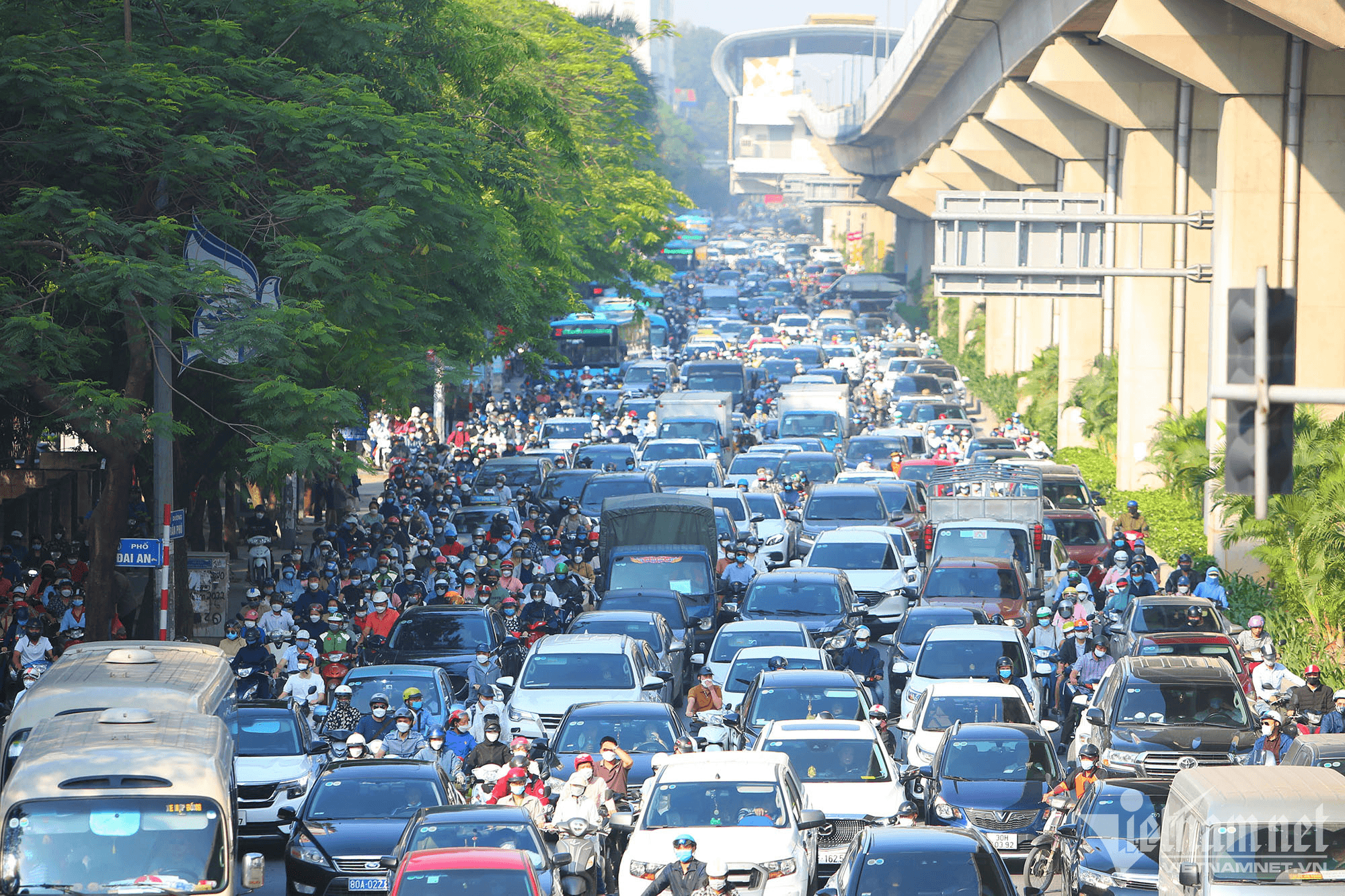
Alongside the road expansion, a metro line was also considered. This indicated that our government did recognize the benefits of public transit in shaping development and reducing traffic congestion. However, they lacked the political will to follow through and prioritize these goals. As a result, it took 10 years to complete a single metro line! To this day, it remains the only finished metro line in Vietnam. While it operates effectively as the only profitable public transit route in Hanoi, one single line cannot meet the high demand for commuting among city dwellers. Consequently, people still rely mostly on their own vehicles, leading to more cars and motorcycle than the road infrastructure can handle.

My story is just one example of how road expansion only exacerbates congestion. These large roads worsen the negative aspects of city living, such as pollution and unsafe pedestrian areas.
Another failed attempt at development is the creation of closed gated communities on the outskirts of cities, similar to suburban areas in the US. These communities are marketed as a "modern lifestyle" where families can meet all their needs within the confines of security. In these communities, mimic the concept of a 15-minute city, simple basic needs are met as the ground floors are typically reserved for shops and supermarkets. However, these places are mostly isolated and lack connections to other parts of the city. As a result, if someone wants to find anything beyond very basic commodities, like a nice restaurant or a gear shop, they have to travel long distances where car is the most suitable method. This phenomenon creates commuter town, where there is no activities on the street in daylight because most people have already leave this place to work (by cars, obviously), and only come here to sleep.
What Can We Do
Unfortunately, without the political will to improve public transportation, there is no way to improve the situation. The metro projects in both Hanoi and Ho Chi Minh City have been planned for decades but lack funding and the political will to materialize. To be honest, urban planners would be more knowledgeable than me in advising the government on city development. However, I understand that, like many designers, urban planners often have little say in the final decision-making process. I hope that this essay can help ordinary people like me understand what constitutes a better way of living and preserve some of the beauty in our sizable cities.
On the bright side, I believe that as cars become increasingly prevalent on the streets and traffic worsens, people are slowly realizing the detrimental effects cars have and are demanding more sustainable ways to build cities. Recently, our government has also discussed Transit-Oriented Development (TOD) projects along new metro lines.
Regardless, we will have to wait for the final results and hope for the best!